
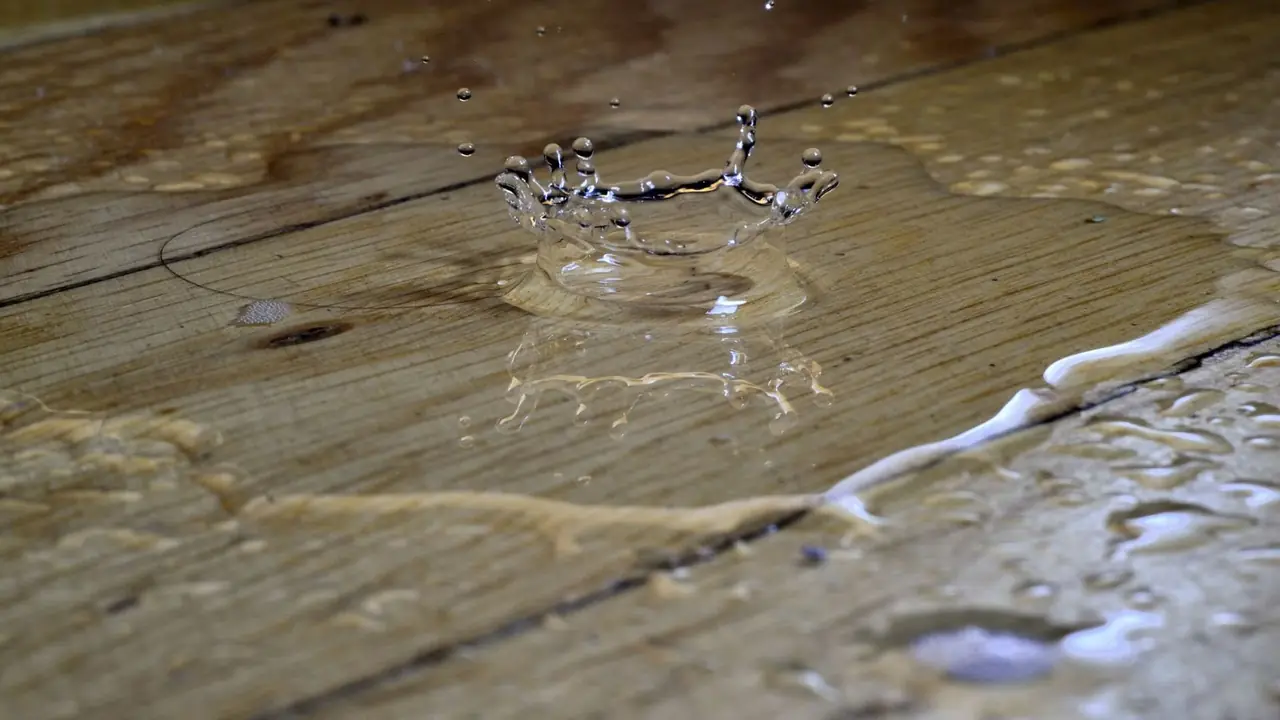
Wood floor water damage shows up slowly. The boards may look fine the night a dishwasher leaks, then the edges curl up a week later. Hardwood and engineered floors react to moisture by swelling, and how they swell tells you a good deal about what happened and what to do.
This guide covers the three main distortions, the usual sources, how drying in place works and the honest cases where the boards have to go.
Cupping, crowning and buckling: three different problems
Cupping means the board edges rise above the center, which usually points to moisture coming from below or one-sided wetting. Crowning is the opposite, with the center higher than the edges. It is often seen after a cupped floor was sanded before it had fully dried.
Buckling is the serious one, where boards lift away from the subfloor. It means the wood has absorbed enough water to push against itself, and the fasteners or glue gave way. Do not walk on a buckling floor more than you must.
| Damage type | What you see | Usual path |
|---|---|---|
| Cupping | Edges raised, center low, boards feel like shallow troughs | Often dried in place, then checked for flattening before any sanding |
| Crowning | Center raised, edges low | Usually follows early sanding of a cupped floor, so wait and re-measure |
| Buckling | Boards lifting off the subfloor in waves | Often partial or full replacement, after assessing the subfloor |
| Edge swelling on engineered planks | Tight, raised seams, chipped finish | Depends on veneer thickness and how long it stayed wet |
| Delamination of engineered layers | Top veneer peeling from the core | Typically replacement of the affected planks |
| Surface staining or black spots | Dark marks, sometimes at nail holes | Needs moisture readings first, then a flooring pro decides |
| Gapping after drying | Visible spaces between boards | Wait for readings to settle, then judge repair |
Where the water usually comes from
Most floor damage traces to a short list of sources. Fixing the source comes first, because drying a floor that is still being wetted does nothing.
Slab moisture deserves special mention because it is silent. A floor glued or floated over concrete can cup from below with no spill at all, and a meter reading on the slab and on a board tells you more than any visible stain. If readings stay high after a leak is ruled out, a flooring professional should look at the moisture barrier.
- A washer supply valve or hose that weeps behind the machine.
- A dishwasher door seal, supply line or drain connection.
- An air conditioner condensate line that is clogged and drips for weeks.
- Moisture rising through a concrete slab, common to floors glued or floated over slab.
- A pinhole plumbing leak under the floor or in the wall behind a toe-kick.
Need a hand with water or mold right now? Dispatch is open 24/7.
☎ Call (760) 769-1159How drying in place works
Technicians scan the boards with moisture meters and infrared cameras, then sketch where the wetness ends. Drying mats or floor drying systems pull air through and under the boards, while air movers and LGR dehumidifiers remove moisture from the room. Readings are taken again each visit and compared to a dry reference board in the same house.
Speed matters but so does restraint. Drying wood too hard can cause cracking or splitting, so a drying plan watches the readings instead of forcing a deadline. Water mitigation in the first days sets up the best chance of saving the floor.
Dry in place or replace? What decides it
Several factors push toward drying. The water was clean, from a supply line (Category 1), the floor was wet for a short time, the boards are solid or thick-veneer and nailed down, and the subfloor reads dry underneath.
Other factors push toward replacing. Washer or dishwasher overflow is Category 2, and flood water from outside is Category 3 under S500 vocabulary. Porous flooring touched by contaminated water is usually removed, and so is flooring that has buckled, delaminated or smells musty. Your restoration company decides after an assessment of the actual readings.
How long to wait before sanding or refinishing
There is no honest calendar number. Wait until moisture readings match your dry reference and stay steady over several visits. Cupping often relaxes as boards dry, and sanding too soon can leave you with crowning later.
Ask your flooring installer or the flooring manufacturer for their moisture and acclimation limits before sanding. Finish products have their own cure and moisture rules, so follow the label. Repairs like sanding and refinishing fall under hardwood floor repair after water damage.
Limits worth knowing before you call anyone
Restoration is not plumbing and it is not waterproofing. If a slab keeps pushing moisture upward, a crew can dry the floor, but it will wet again until the cause is addressed, and that fix may belong to a plumber or a flooring professional.
If standing water is still on the floor, emergency water removal gets it off the boards fast. Keep out of a room if water has reached an outlet or the breaker panel.
Twentynine Palms local note: dry air does not mean a dry floor
NOAA 1991 to 2020 normals put annual rainfall and melt at roughly 3.87 inches in Twentynine Palms. Outdoor air is dry most days, and a house run on air conditioning can be drier still. That is why you should compare readings to a dry reference board in your own house, not a figure from a manual.
County Public Works says monsoon rains in July 2024 flooded the Zone 6 area and damaged flood control works there. Runoff that comes through a door or over a slab edge is outside water, so Category 3, and it tends to reach flooring first. Homes in Yucca Valley and Morongo Valley see the same problem when a storm hits, so check the floor edges even if the room looks dry.
Source type: NOAA climate normals (1991 to 2020) and a county Public Works notice from CEQAnet
Frequently asked questions
Why did my Twentynine Palms floor cup even though the climate is so dry?
Wood moves with the moisture around and under it, and a dry climate does not stop a slow leak. A clogged AC condensate line or a weeping appliance valve can keep one area wet in an otherwise dry house. Find the source, then have moisture readings taken against a dry reference.
Can a cupped floor be fixed without replacing it?
Often, if the boards dry and flatten on their own, though it can go either way. Sanding comes after readings are stable, not before. If boards have lifted off the subfloor, replacement is more likely.
Should I pull up a few boards to help the floor dry?
Only if the crew recommends it. Lifting a board or baseboard can open a path for air into a wet cavity, but doing it yourself can damage the tongue and groove or hide evidence. Photograph first and ask the crew.
Do engineered floors handle water better than solid hardwood?
Not necessarily. Engineered planks can swell at the seams and the layers can separate. The outcome depends on the veneer, the core, the glue and how long the floor stayed wet.
Talk it through with dispatch any hour of the day.
☎ Call (760) 769-1159