
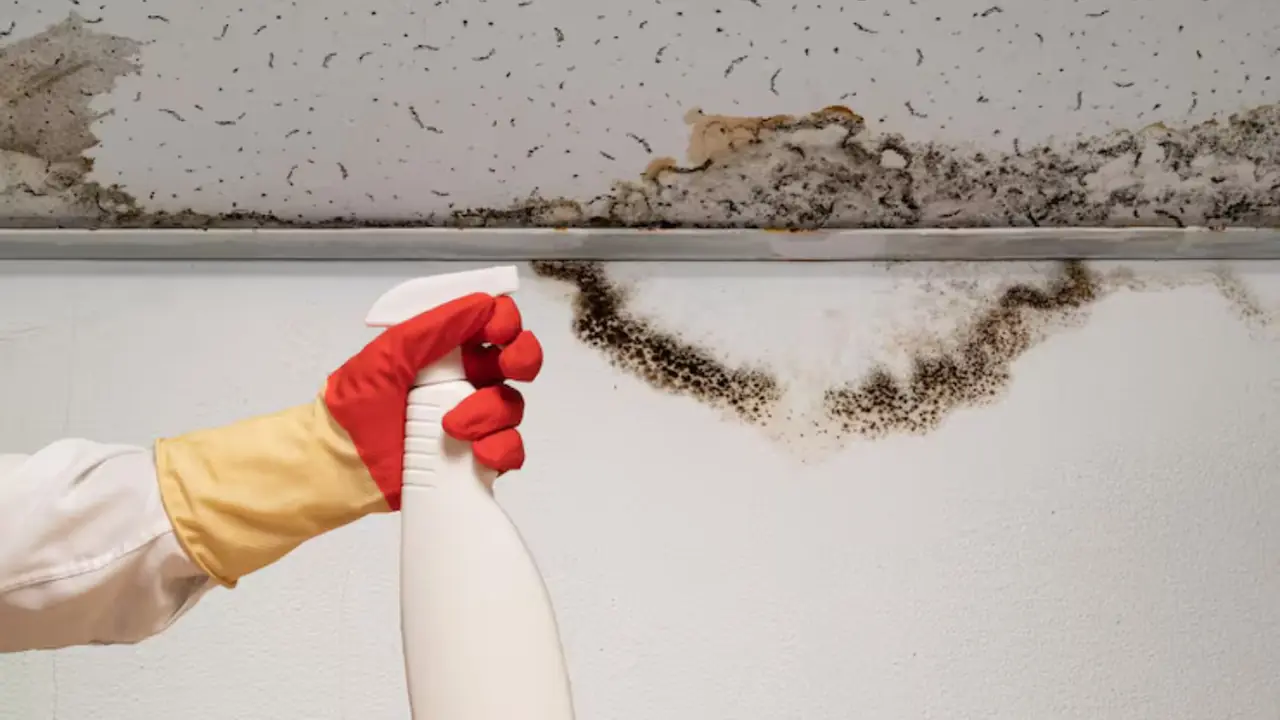
A brown ring on the ceiling that spreads into gray or black spots is the usual sign of mold overhead, and it always means moisture is reaching the drywall from somewhere. Knowing how to remove mold from a ceiling starts with finding that moisture. Wiping the spot while the leak continues only resets the clock.
In Twentynine Palms the water often shows up in one burst. A monsoon storm can push rain under worn roofing or past failed flashing, and the stain appears days later when the sky is clear again. This guide covers the four common sources, what to do with flat drywall versus textured ceilings, ladder and wiring cautions, and the point where cutting the ceiling out is the only sensible answer.
Four usual sources, and how to tell them apart
Roof leaks leave a stain with a ragged edge that grows after rain, often near a vent pipe, chimney or skylight. Plumbing leaks from an upstairs bathroom or an attic supply line make a rounder stain that keeps growing on dry days. The weather is your quickest test, because a stain that only changes after a storm points at the roof first.
Air conditioner condensate lines are the quiet culprit in desert homes. When an attic air handler has a clogged drain line or an overflowing safety pan, water drips onto the ceiling directly below it. Bathroom fans that vent into the attic instead of outdoors push warm, wet air against cooler surfaces, and that makes a scatter of small spots instead of one large stain.
- Stain grows only after rain: roof, flashing or a vent boot
- Stain grows on dry days under a bathroom or kitchen: supply or drain line
- Stain sits below the attic air handler: condensate line or pan
- Scattered spots around a fan: exhaust venting into the attic
Ladder, wiring and light fixture cautions
Water and electricity share ceilings more often than people expect. If a light fixture is dripping, a ceiling fan is wet, or the drywall is sagging around a junction box, stay out from under it.
When the ceiling hangs below a wet floor or a light fixture, turn off that circuit only at a panel you can get to without crossing water. Sparks, a burning smell or any hint of gas means the utility or 911 gets the first call, ahead of any cleanup company.
Sagging drywall can hold gallons and drop without warning. Never stand beneath it while you work. Set the ladder on dry, level floor, keep your belt buckle between the rails, and wear eye protection and a respirator rated for fine particles whenever you disturb anything dark or powdery.
Need a hand with water or mold right now? Dispatch is open 24/7.
☎ Call (760) 769-1159Ceiling type at a glance
The surface decides how much you can do yourself. Use this table to match what you see to a safe first step.
| Ceiling type | What it looks like | Reasonable first step | Stop and get it assessed if |
|---|---|---|---|
| Smooth painted drywall | Spots or a ring on the paint | Dry it, clean the surface, then prime with a stain-blocking primer | Paint bubbles or the board feels soft |
| Knockdown or orange-peel texture | Spots settled in the ridges | Light wiping only, no scrubbing that loosens the texture | Texture flakes off in sheets |
| Popcorn spray texture | Spotting that sinks into the soft layer | Do not scrub or scrape, mark the edge with a pencil and watch it | Any stain bigger than a dinner plate |
| Tongue-and-groove wood | Dark staining that follows the grain | Dry it and wipe the sealed surface | A screwdriver sinks into the board |
| Suspended tile panels | Dark spots on the panel face | Replace the stained panels and check above them | Spots on more than a few panels |
Cleaning sound, stained drywall
Fix the source first, then dry the area with a fan until a moisture meter or a firm press shows no dampness. Wipe with detergent and water on a damp cloth, working from clean toward stained, and bag the rags before you carry them through the house. If the board stays firm and the stain is smaller than a dinner plate, this is often all the surface needs.
Skip the paint-over. Fresh paint on a damp or unclean ceiling hides the problem for a few weeks and then the ring returns. Bleach mostly lightens the face of porous paper, so a paler stain does not prove the growth is gone.
Why popcorn and heavy texture need different handling
Spray texture soaks up water like a sponge, and scrubbing it smears the stain and sheds material into the room. Texture on an older home can also contain asbestos, so have a sample tested by a lab before you scrape, sand or scrub it. If the test is positive, that changes the whole job.
For small, dry spots on a texture you have cleared, a soft brush and a vacuum with a HEPA filter are gentler than a wet cloth. For anything larger, a crew can seal the area and remove the affected section instead of working it in place. You can read how that process works on the mold remediation page.
When the ceiling has to be cut out
Cleaning the face cannot fix a ceiling that is wet behind the surface. Cut-out becomes the answer when the board sags or crumbles, when the stain returns after drying, or when the water came from a toilet, sink or washing machine overflow upstairs. It is also the answer when insulation above is soaked, because wet insulation keeps the board damp for weeks.
A crew sets containment barriers and runs a HEPA air scrubber, then cuts past the visible edge so the new seam lands on clean, dry board. The cavity gets dried, wet insulation is replaced, and the ceiling is rebuilt with new drywall, texture and paint. That rebuild stage is covered under ceiling and wall repair.
- Board is soft, bowed or sagging
- Stain returns within weeks of cleaning
- Water came from a toilet, sink or washer upstairs
- Insulation above is wet or matted
- Growth covers more than a dinner plate
- A musty smell stays after the surface is clean
Twentynine Palms local note: one storm, one weak spot
Annual rainfall here averages roughly 3.87 inches by NOAA's 1991 to 2020 normals, and August is the wettest month at 0.65 inches, driven mostly by monsoon thunderstorms. Because roofs here face few wet days, a small flashing gap can go unnoticed for months and then show itself after a single storm. Walk the ceilings after each storm and photograph any new stain with the date.
In a notice filed with the state, county Public Works reported serious flooding after heavy monsoon rain in July 2024 across Flood Control District Zone 6, mainly in Twentynine Palms. Wind-driven rain and runoff are different problems, so if the water also came in at a door or crawl space, flood damage is a separate question. Homes in Joshua Tree and Yucca Valley see the same monsoon pattern.
Source type: NOAA climate normals for 1991 to 2020, plus a July 2024 county Public Works notice posted on CEQAnet
Frequently asked questions
Can one monsoon storm cause ceiling mold in Twentynine Palms?
Yes, if water gets into the attic or ceiling cavity and stays damp. A brief storm can soak insulation and drywall, and dry desert air does not always reach the wet layers fast enough. Check the ceiling and attic on a dry day after any heavy storm.
Is it safe to paint over a ceiling stain?
Only after the source is fixed, the area is dry and the surface is clean. Painting over a damp stain usually brings it back. A stain-blocking primer helps once those steps are done.
Do I have to replace the whole ceiling?
Usually not. Crews cut out the affected section and a margin around it, then match the texture. A larger cut-out is needed when moisture mapping shows wet board beyond the visible stain.
Who fixes the leak and who handles the mold?
A roofer, plumber or air conditioning technician fixes the source. Crews dry the structure and deal with moldy materials, while S520 practice guides testing and remediation, so ask each company if its work follows ANSI/IICRC S520. Health questions belong with a physician.
Talk it through with dispatch any hour of the day.
☎ Call (760) 769-1159