
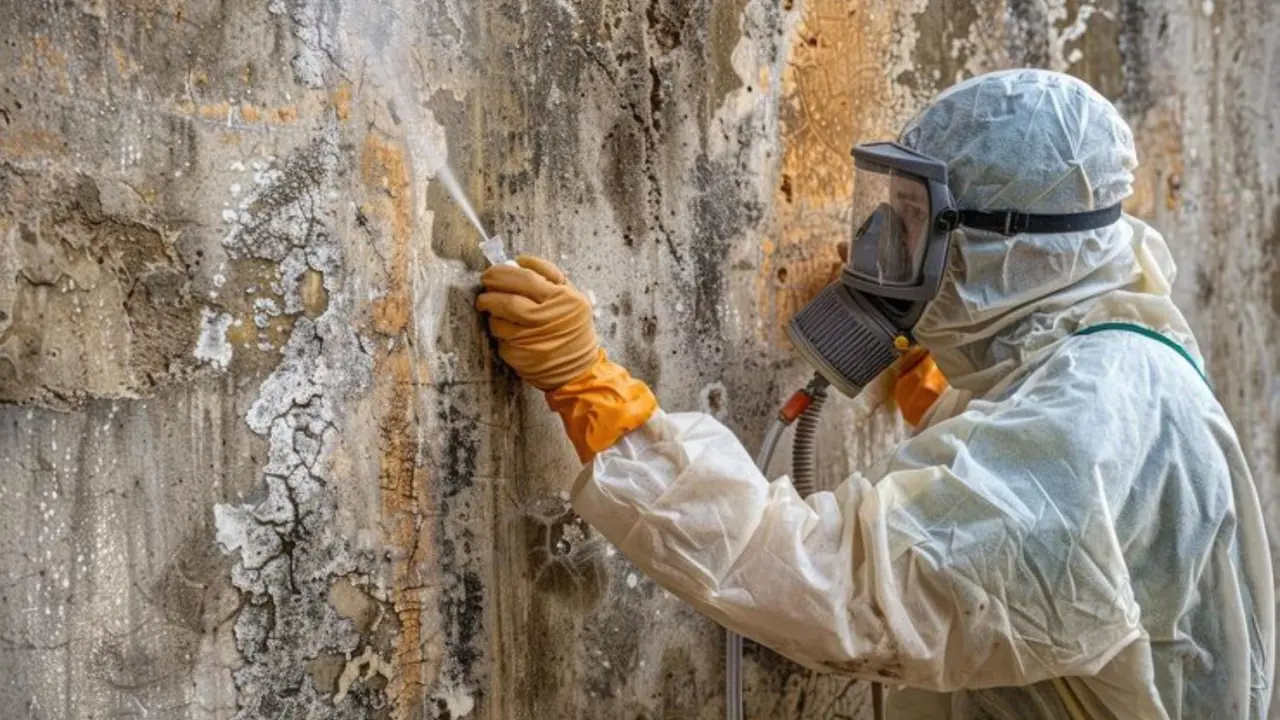
Getting rid of basement mold starts with tracking down the moisture feeding it, because the growth only signals that water is or was present. Scrubbing a stained wall while the pipe behind it still weeps is the reason many cleanups fail. This guide walks through four phases in the order that works.
The sequence fits a basement, a cellar, a sunken den or, in a house with none of those, a slab-edge wall, a water heater closet, a garage or a crawl space. Each phase has a tool or a check, so you know when to move on instead of guessing.
Why the order matters more than the cleaner
The EPA's brief guide to mold puts it bluntly: if you clean up the mold but do not fix the water problem, the mold problem will most likely come back. That is why every step below is arranged around moisture and not around products.
Picture a utility sink supply line that drips one drop a minute behind a closet wall. A homeowner wipes the visible patch twice a year and never opens the wall. Phase 1 exists to stop that loop.
The four phases at a glance
Work down the table. Do not start a phase until the one above it has been checked off with the tool or check listed in the right-hand column.
| Phase | What happens | Tool or check |
|---|---|---|
| 1. Find the source | Trace every possible water path, from plumbing to grading | Moisture meter, thermal imaging camera, plastic sheet test |
| 2. Fix and dry | Repair the leak, extract standing water, dry framing and slab | Air movers, LGR dehumidifier, daily moisture readings |
| 3. Control humidity | Hold the room at a steady relative humidity | Hygrometer, 30 to 50 percent target |
| 4. Remove and rebuild | Take out materials that cannot be saved, clean, then repair | Containment, HEPA air scrubber, written scope |
Need a hand with water or mold right now? Dispatch is open 24/7.
☎ Call (760) 769-1159Phase 1: find the moisture source
Walk the room with a flashlight and a moisture meter, and look for the stain that is darkest, not the one that is largest. Pipes, water heater connections, washing machine hoses, window wells, slab cracks and the base of exterior walls are the usual suspects.
Outside the wall, check where the roof drains, where irrigation sprays and which way the soil slopes. Water that is pushed against a foundation for months will find its way in.
A simple plastic sheet test helps with doubtful spots. Tape a one foot square of plastic tightly to the wall or slab for a day. Moisture under the plastic points to water coming through the surface, while droplets on top of it point to room humidity.
- Supply lines, shut-off valves and water heater fittings
- Drain lines, floor drains and condensate lines
- Roof runoff, downspout outlets and irrigation heads near the wall
- Cracks at the slab edge and where pipes pass through the wall
Phase 2: fix the source and dry the structure
Repair comes before drying. Call a plumber for a failed line or a roofer for a runoff problem, because restoration crews dry and clean and are not a substitute for either trade.
Drying then means removing standing water, opening wet cavities and running air movers and LGR dehumidifiers until moisture meter readings match a dry reference wall. Our water mitigation work is built around that process of moisture mapping and structural drying.
The EPA suggests a 24 to 48 hour target for drying wet areas and items. In a larger event that target gets hard to meet, which is one reason to call early.
Phase 3: control humidity while materials dry
The EPA recommends keeping indoor relative humidity below 60 percent, ideally between 30 and 50 percent. A cheap hygrometer on the wall of the affected room tells you where you stand, and a dehumidifier sized for the room does the rest.
Keep the door closed while equipment runs so you are not drying the whole house. If the room has a return air duct, close it off or ask a professional how to isolate it, so air from the wet space is not pulled into other rooms.
Safe working conditions for each phase
Every phase of the job has its own hazards, so run through this list each time you return to the work.
- Fix the water source before anything else, and confirm the plumbing is shut off.
- Never run a dehumidifier or fan from an extension cord lying in standing water.
- Open windows or doors while working, and keep household members out of the room.
- Lift heavy wet materials with a helper, since waterlogged carpet and board weigh far more than they look.
- Take a break and reassess if a ceiling or floor begins to sag.
Phase 4: remove, clean and rebuild
Only now do you deal with the growth. Hard, non-porous surfaces such as concrete, tile and metal can often be cleaned and dried in place. Wallboard, insulation and carpet that grew mold are usually cut out and bagged.
When the area is large or the material is soft, a crew sets up containment barriers and HEPA air scrubbers before demolition, which is the heart of mold remediation work. After that, rebuilding the wall and floor begins, and nobody should close a wall before readings are dry.
Do not paint over stains to finish the job. The EPA says to clean and dry first, and fresh paint on a damp wall hides the evidence you will want later.
How to tell the job is actually finished
Finished means dry readings that hold for several days, no new staining, and a humidity reading that stays in your target range. It does not mean the room smells like cleaner.
If you are working with a company, ask whether crews follow ANSI/IICRC S500 for drying and S520 for mold, and ask them to show final moisture readings. Restoration is not waterproofing, so if water keeps arriving from outside you may also need a grading or foundation contractor, and a Landers or Morongo Valley address does not change that advice.
Twentynine Palms local note: septic systems and low rooms
The 2022 LAFCO review found no municipal sewage collection or treatment plant serving Twentynine Palms, so private septic systems handle most buildings. For Phase 1 that means a damp low wall near a tank or leach field deserves a septic contractor's look, along with the usual plumbing checks.
If the moisture is wastewater and not clean water, stop and treat it as a contamination job. Keep people and pets out, let the septic contractor fix the system first, and restoration crews handle the soaked materials afterward. The same service review notes the City Council approved pursuing state funding for a wastewater system in February 2022, but check with the city on where that stands.
Source type: LAFCO 3252 service review, Twentynine Palms community (San Bernardino LAFCO, September 2022), EPA brief guide to mold
Frequently asked questions
My basement room is near a septic tank, so who do I call first?
If you see wastewater, smell sewage or have slow drains and a wet area, call a septic contractor first and keep people and pets out of the room. Once the system is repaired, a restoration crew can handle the contaminated materials. A flood and contamination team can explain what comes out and what can be cleaned.
How long should drying take before I can rebuild?
It depends on the material and the amount of water. Crews track daily moisture readings and rebuild when framing and slab match a dry reference, not on a fixed number of days.
Can I just run a dehumidifier and skip the rest?
A dehumidifier helps in Phase 3 but it cannot fix a leak or dry wet drywall that is trapped behind paint. Find and repair the source, dry the structure, then use humidity control to keep conditions steady.
Will my insurance pay for this?
A sudden pipe failure is often covered, a slow leak often is not, and flood damage usually needs a separate flood policy. Talk to your insurer and read the policy language first, ahead of any tear-out.
Talk it through with dispatch any hour of the day.
☎ Call (760) 769-1159