
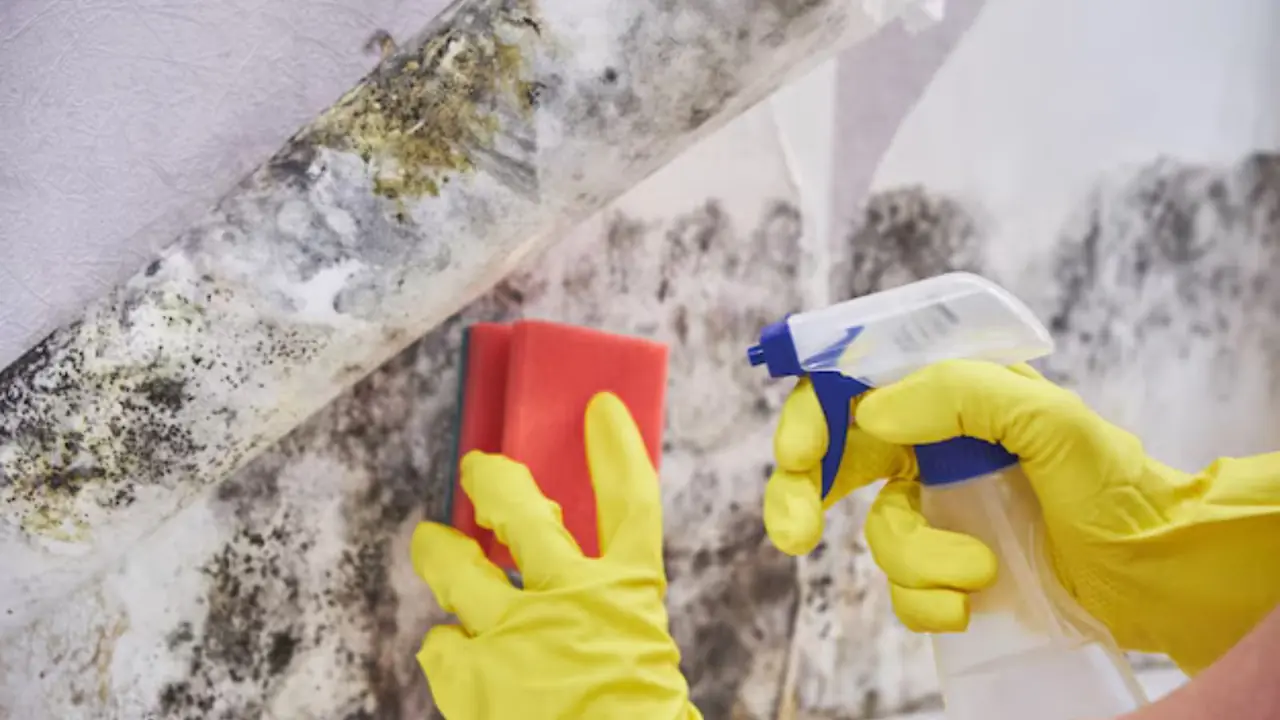
Knowing how to clean up mold in a basement starts with a sorting question, not a scrub brush. Some surfaces can be cleaned by a careful homeowner, and others have to come out. The advice below fits a dug-out lower room if you have one, and it fits slab-edge walls, closets, garages and crawl spaces in Twentynine Palms, CA just as well.
The U.S. EPA's brief guide to mold says that when the moldy area is under about 10 square feet, roughly a 3 foot by 3 foot patch, you can usually handle it yourself. Larger areas call for more advanced guidance. Size is only one test, because the material under the patch matters just as much.
Mold needs moisture, so no cleanup holds while the water source is still active. Find the leak, runoff path or condensation first. Then decide what you can wash and what you cannot.
Sort the job before you touch anything
Walk the space with a flashlight and a notepad. Measure each patch, note what it is growing on, and take photos. Mark any spot that feels damp, cool or soft, because a visible patch is often only the edge of a wetter area behind it.
Three questions sort most jobs. Is the patch under about 10 square feet, on a hard sealed surface, with the cause fixed and the area dry? Three yeses mean light cleaning is reasonable. One no means read on carefully, and two noes mean stop and call.
Non-porous versus porous: what gets washed and what gets bagged
Non-porous materials do not absorb water, so growth sits on the surface and can be scrubbed off. Porous materials draw moisture in, and growth works into the fibers where a cloth cannot reach. EPA guidance says things that soak up water, like ceiling tiles and carpet, can end up in the dumpster if mold gets into them.
Use the table as a first pass. A professional with a moisture meter may change the call on any row.
| Material | Type | Usual approach |
|---|---|---|
| Glazed tile, sealed concrete floor | Non-porous | Scrub with detergent and water, then dry completely |
| Metal shelving, plastic bins, glass | Non-porous | Wash, dry, and return only after the room is dry |
| Solid wood framing, light surface growth | Semi-porous | Small areas only, otherwise leave it to a crew |
| Drywall and ceiling tile | Porous | Cut out and bag, do not scrub |
| Carpet, pad, cardboard boxes | Porous | Remove and bag |
| Fiberglass insulation | Porous | Remove, and call a professional if it sits inside a wall |
| Paper goods and books | Porous | Bag, or photograph first if they matter |
Need a hand with water or mold right now? Dispatch is open 24/7.
☎ Call (760) 769-1159Containment and protective gear for a small job
Scrubbing stirs spores into the air, so keep them in the room where you are working. Close the door to the rest of the house, tape plastic sheeting over doorways and supply vents, and set a box fan in a window or door so air moves outward. Turn off any furnace or air handler serving that space so it does not pull dust through the ductwork.
Wear a fitted particle respirator, rubber gloves and sealed goggles, plus clothes you can bag and wash right away. Follow the respirator maker's fit instructions, since a loose mask does little. Double-bag debris in thick plastic, wipe the outside of each bag, and carry it out by the shortest route.
What S520 means for a homeowner
ANSI/IICRC S520 is the published industry standard for professional mold remediation. It describes accepted practice for assessing a mold problem, containing the work area, removing growth and checking the result. Reading it is optional, yet it is fair to ask every contractor whether the crew follows S520 before you hire.
The standard also reflects a simple point. Remediation means removing growth and correcting moisture, not painting over stains. Be careful with any offer that amounts to a spray or a coat of sealant on stained material.
When to stop scrubbing and call
Stopping early costs less than spreading a problem through the house. Call a professional if any of these apply:
- The affected area is larger than about 10 square feet
- Growth shows behind or inside a wall, under flooring or near the HVAC system
- The water was sewage or flood water from outside
- Drywall, insulation or carpet is still saturated
- The smell comes back after you clean and dry the area
- Anyone in the home has health questions, which belong with a physician
Where a professional crew fits in
When water is still present, emergency water removal comes first, because mold cleanup on a wet room is wasted effort. Once the space is drying, a crew can set up containment, cut out porous materials and run HEPA air scrubbers under mold remediation practice. Scope and price come up before any work begins.
Where water has touched outlets, a panel or gas appliances, keep out of that room. Only throw the main switch if the panel is reachable without wading, and for any electrical or gas hazard, phone the utility or 911 ahead of us. We also work in Joshua Tree and Yucca Valley if you have family or a second property out that way.
Twentynine Palms local note: dry years, sudden wetting
NOAA 1991 to 2020 normals put annual precipitation near 3.87 inches, and the wettest month, August, averages only 0.65 inches, mostly from monsoon thunderstorms. Rain here comes as short, hard storms on dry ground, so water in a lower room is usually runoff from one specific event. Ask which event wetted the space, a storm, a supply line or a water heater, because the date tells you how long materials stayed damp.
Most homes here run on private septic systems, since there is no organized municipal sewage collection. If the dampness in a lower room came with a sewage smell, treat it as a septic or leach field matter first. A septic contractor handles the system, and restoration crews handle the contaminated materials afterward.
Source type: NOAA normals for 1991 to 2020 and the 2022 San Bernardino LAFCO 3252 service review
Frequently asked questions
Can mold really grow in a Twentynine Palms lower room when the climate is so dry?
Yes. Mold needs moisture, not a wet climate, and monsoon runoff, a slow plumbing leak or condensation on a cool wall can supply it. With so little rain in a normal year, the cause is usually an event you can trace, which makes it easier to find and fix.
How dry does the area need to be before I clean?
EPA guidance calls for drying wet areas and items inside 24 to 48 hours so mold does not start, and for washing hard surfaces with detergent and water before drying them fully. If a wall or floor still reads wet on a moisture meter, cleaning the surface will not hold.
Should I test the mold before I clean it?
Testing does not replace fixing the moisture, and it does not change how a small hard-surface patch is cleaned. If you want testing and inspection, ask a company how it follows S520 practice and what the results would change in the scope of work.
Does homeowners insurance pay for mold cleanup?
It depends on the cause and the policy. Insurers often treat sudden, accidental water damage differently from slow leaks, and flood damage usually needs separate flood coverage. Read your policy and talk to your insurer ahead of the work.
Talk it through with dispatch any hour of the day.
☎ Call (760) 769-1159